
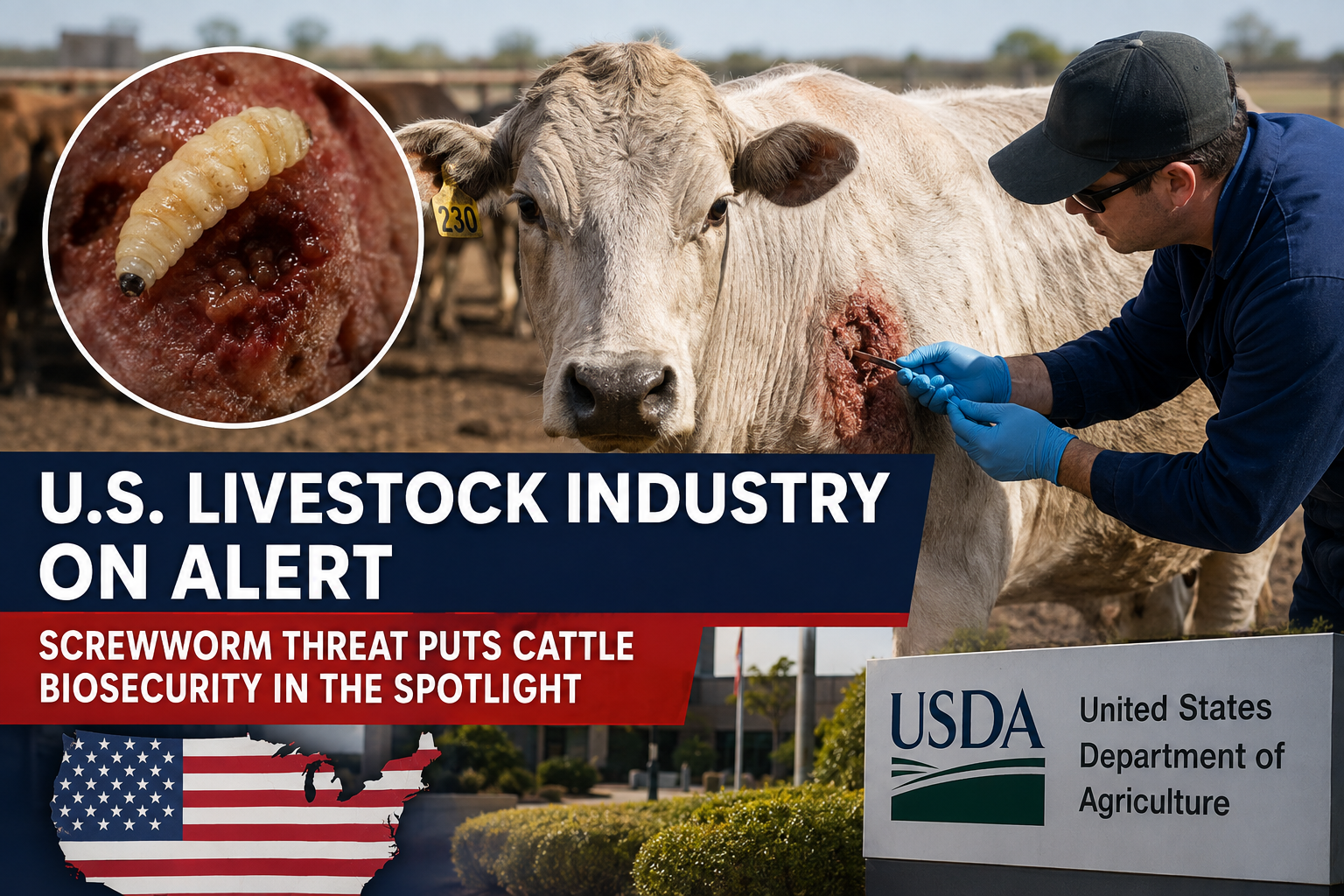
A dangerous livestock parasite has returned to the United States, putting cattle producers and animal-health officials on heightened alert and reinforcing the growing importance of farm biosecurity.
The U.S. livestock industry is closely watching the spread of New World screwworm, a destructive parasite capable of causing severe injuries and even death in cattle and other warm-blooded animals.
The U.S. Department of Agriculture (USDA) confirmed New World screwworm in a calf in Zavala County, Texas, in June 2026. The discovery has triggered increased surveillance and control efforts aimed at preventing the parasite from becoming established in the country’s livestock population.
What Is New World Screwworm?
Unlike many parasites that feed on dead tissue, New World screwworm larvae can infest open wounds and feed on the living tissue of animals.
Adult female flies lay their eggs around wounds or openings in an animal’s skin. After the eggs hatch, the larvae enter the wound and begin feeding.
For livestock producers, an infestation can quickly become a serious animal-health problem if it is not detected and treated.
Cattle are particularly important to the U.S. response because of the enormous size and economic importance of America’s beef industry.
Why U.S. Farmers Are Paying Attention
The threat comes at a sensitive time for American cattle producers.
U.S. cattle supplies remain relatively tight, while cattle and beef prices have been elevated. Any disease or parasite capable of affecting animal health, livestock movement or production therefore attracts significant attention.
USDA has increased surveillance and coordinated control efforts to reduce the possibility of New World screwworm spreading.
The agency currently says the risk to animals and people in the United States remains very low and emphasizes that the situation is not considered a food-safety issue.
Livestock Trade Is Also Part of the Story
The screwworm situation has affected livestock movement between the United States and Mexico.
USDA announced plans for a phased reopening of southern ports for livestock imports, beginning with Douglas, Arizona, on August 24, 2026, provided required animal-health conditions are met.
The movement of cattle, bison and horses across the border has become an important part of efforts to balance livestock trade with disease prevention.
It demonstrates how quickly an animal-health problem can become a wider agricultural and economic issue.
What Farmers Should Watch For
Livestock owners should regularly inspect animals, particularly those with cuts, wounds or recent surgical procedures.
Possible warning signs can include wounds that become unusually large or fail to heal, visible larvae inside a wound, unusual discharge or odor, animals repeatedly licking or scratching affected areas, reduced appetite, weakness and abnormal behavior.
Farmers who suspect New World screwworm should avoid relying on guesswork and contact appropriate veterinary or animal-health authorities.
Early detection can make a major difference.
The Bigger Lesson for Livestock Farmers
The situation in the United States carries an important lesson far beyond America’s borders.
Biosecurity is becoming one of the most important investments in modern livestock farming.
A farm can have excellent genetics, quality feed and strong market demand, but an animal-health outbreak can quickly erase those advantages.
Farmers should maintain good records, quarantine newly purchased animals when appropriate, inspect livestock regularly, keep housing and handling areas clean, treat wounds promptly and report unusual disease patterns.
These practices may appear simple, but they can protect an entire livestock operation.
A Tiny Parasite, a Multibillion-Dollar Industry
The New World screwworm situation demonstrates something every livestock farmer should remember:
The biggest threat to a farm isn’t always the biggest animal.
Sometimes something almost invisible can threaten livestock health, disrupt international trade and force an entire industry to strengthen its defenses.
For livestock producers, prevention and early detection remain far cheaper than dealing with a major outbreak.
Ajile Farms will continue monitoring developments affecting livestock farmers in the United States, Africa and around the world.

Leave a Reply